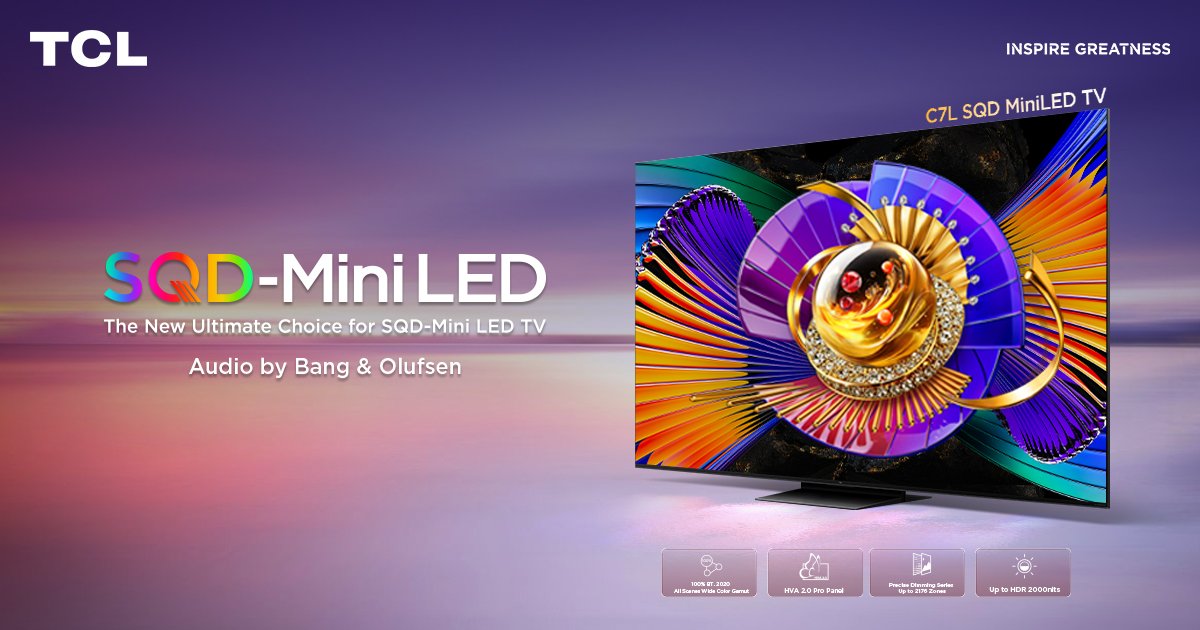
A new category of display technology has arrived in Pakistan. Understanding what makes it genuinely different, not just incrementally better, requires looking at what conventional display technology has never been able to get right.
Most televisions are sold on the basis of a number. Brightness in nits. Screen size in inches. Refresh rate in hertz. These specification figures have become the currency of the premium television market, measurable, comparable and easy to communicate at retail. But on their own, they tell only half the story of picture quality.
A screen can be extremely bright and still produce inaccurate colour. It can have thousands of dimming zones and still create visible halos around bright objects. It can be technically impressive and still fall short in the conditions that matter most at home: bright rooms, multiple viewers and varied content throughout the day. SQD-Mini LED TV is TCL’s response to this gap, not simply another specification upgrade, but a panel-level redesign of how light, colour and contrast work together, engineered by the company that manufactures more 85-inch and above television panels than anyone else on earth.
What SQD stands for, and why the particle matters
SQD stands for Super Quantum Dot. Quantum dots are nanoscale particles that convert the television’s backlight into precisely characterised red, green and blue light. The concept has been effective in premium televisions for several years. But conventional quantum dot systems have always carried an imprecision in the conversion process. Particle size variations and core-shell structural irregularities introduce colour inaccuracies that compound across the full screen.
TCL’s Super QLED adjusts quantum dot particle size and redesigns the core-shell structure at the material level. The conversion from backlight to colour becomes more precise, producing purer greens, deeper reds and cleaner whites. Colour accuracy in SQD-Mini LED TV starts here, before the image has even reached the panel’s filter layer. That’s the power of the SQD-Mini LED.
Precise Dimming Series: solving the halo problem for good
When a bright object appears against a dark background, a white subtitle, a stadium floodlight or a candle flame, a conventional display’s local dimming system can create a visible glow around the bright area. Light from the zones illuminating the bright area spills into surrounding dark zones. The result is an unmistakable halo that undermines depth and realism.
Precise Dimming Series redesigns local dimming at the system level. The engineering enables one zone to perform with the precision of multiple, sculpting light rather than simply controlling it in blocks. In the flagship X11L, this translates to over 20,000 local dimming zones. In practice, a genuinely dark night sky can appear in the same frame as a bright street lamp, and neither compromises the accuracy of the other.
Ultra Color Filter: closing the loop
The third breakthrough works at the colour filter layer of the panel itself. Standard colour filters, even on high-performance displays, introduce impurity into the final colour output, a slight blurring of colour channel boundaries that accumulates into visible inaccuracy at full screen size on large panels. Ultra Color Filter significantly enhances the filtering precision of the colour resist layer, preserving the colour improvements made upstream by Super QLED and Precise Dimming Series all the way to the finished image.
What this means in a home in Pakistan
In Pakistan, where bright sunlight and well-lit interiors are common features of the home, SQD-Mini LED TV’s 10,000-nit peak brightness helps keep images vivid and accurate across different room conditions. OLED televisions reach approximately 2,000 nits, making strong ambient light a challenge for maintaining picture impact. SQD-Mini LED TV, by contrast, combines significantly higher brightness with inorganic LEDs that offer a 60,000-hour lifespan and zero burn-in risk from static elements such as game interfaces, news tickers or streaming menus.
For sports viewing, particularly cricket and football in Pakistan, precise light control means fast motion retains clarity and preserves the detail and intent of the original broadcast. For gaming, HDR performance and VRR support ensure the visual environment is rendered as its designers built it. For cinema, deep blacks and precise highlights bring the director of photography’s vision to the screen.
Available in the C7L, C8L and flagship X11L from 55 to 98 inches, SQD-Mini LED TV is more than an upgrade to individual specifications. It is a fundamental rethink of how a television produces its image.