Pakistan’s prison crisis is no longer a story about overcrowded jails alone. It is a story about who Pakistan puts behind bars, who remains there without conviction, and what happens when imprisonment becomes the default response to poverty, minor offences and unresolved cases. The National Commission for Human Rights (NCHR) and Justice Project Pakistan’s new report, launched with the support of the European Union, paints an alarming picture: 110,513 people are now in prison, three in every four are under-trial, and more than 28,000 are imprisoned under drug laws. This raises the question: why are so many people being imprisoned in the first place, and what will it take to reform this approach?
The report analyses Pakistan’s prison crisis as a reflection of how the criminal justice system uses imprisonment, including who is arrested, access to bail, the speed of trials, the offences that are criminalised, and the availability of alternatives to imprisonment.
Now in its second edition, the Annual Prisons Data Report 2026 is Pakistan’s only annual, published national compilation of prison data, bringing together the latest official data from across the country in one place. It turns fragmented provincial records into a national picture of who is in Pakistan’s prisons, why they are there and where the system is under the greatest pressure, providing an evidence base for policymakers, courts, oversight bodies, researchers and the public.
“These are not just numbers. Behind every number is a person, a family and a life that has been disrupted,” said Sarah Belal, Executive Director of Justice Project Pakistan. “The purpose of this report is to give policymakers, criminal justice actors and donors the evidence they need to make better decisions, and to show that different approaches are possible. The tools we are launching alongside the report are about taking that evidence one step further: helping civil society and those working inside the system in their reform efforts.”
Key findings from the 2026 report show that Pakistan’s prisons are operating at 160.6% of authorised capacity, holding 110,513 prisoners against space for approximately 68,832 — 41,681 more people than the system is designed to accommodate. Three in every four prisoners are under-trial: 82,988 people, or 75.09% of the national prison population, are under-trial, and this population alone exceeds Pakistan’s total authorised prison capacity by 14,156 people.
In his opening remarks at the event, Jeroen Willems, Head of Partnerships, European Union Delegation in Pakistan said: “Over the past year, there have been significant efforts to improve prison conditions in Pakistan. Earlier this year, a Prison Management Information System was launched in Balochistan, alongside similar initiatives across five prison centres in Khyber Pakhtunkhwa. If all goes well, an agreement will also be signed with UNODC to further improve prison management and conditions in Khyber Pakhtunkhwa. Pakistan can count on the support of the European Union in these efforts.”
The report identifies drug-related imprisonment as another major driver of prison growth, with more than 28,000 people held under the Control of Narcotic Substances Act (CNSA) — more than one quarter of the entire prison population — representing a 43.4% increase since 2023. The report also shows that prison growth is not an inevitability: while Punjab and Sindh continue to face sharp increases and severe overcrowding, Khyber Pakhtunkhwa and Balochistan have reduced their prison populations and remain within their overall authorised capacity, with greater use of probation, parole, diversion and other alternatives to imprisonment contributing to this trend. The pressure is also unevenly distributed across vulnerable groups. The number of women in prison has increased by 45.96% since 2024, while 86.2% of children in prison are under-trial. By contrast, Pakistan’s death-row population has fallen to 3,220, an 11.7% decline from 2024.
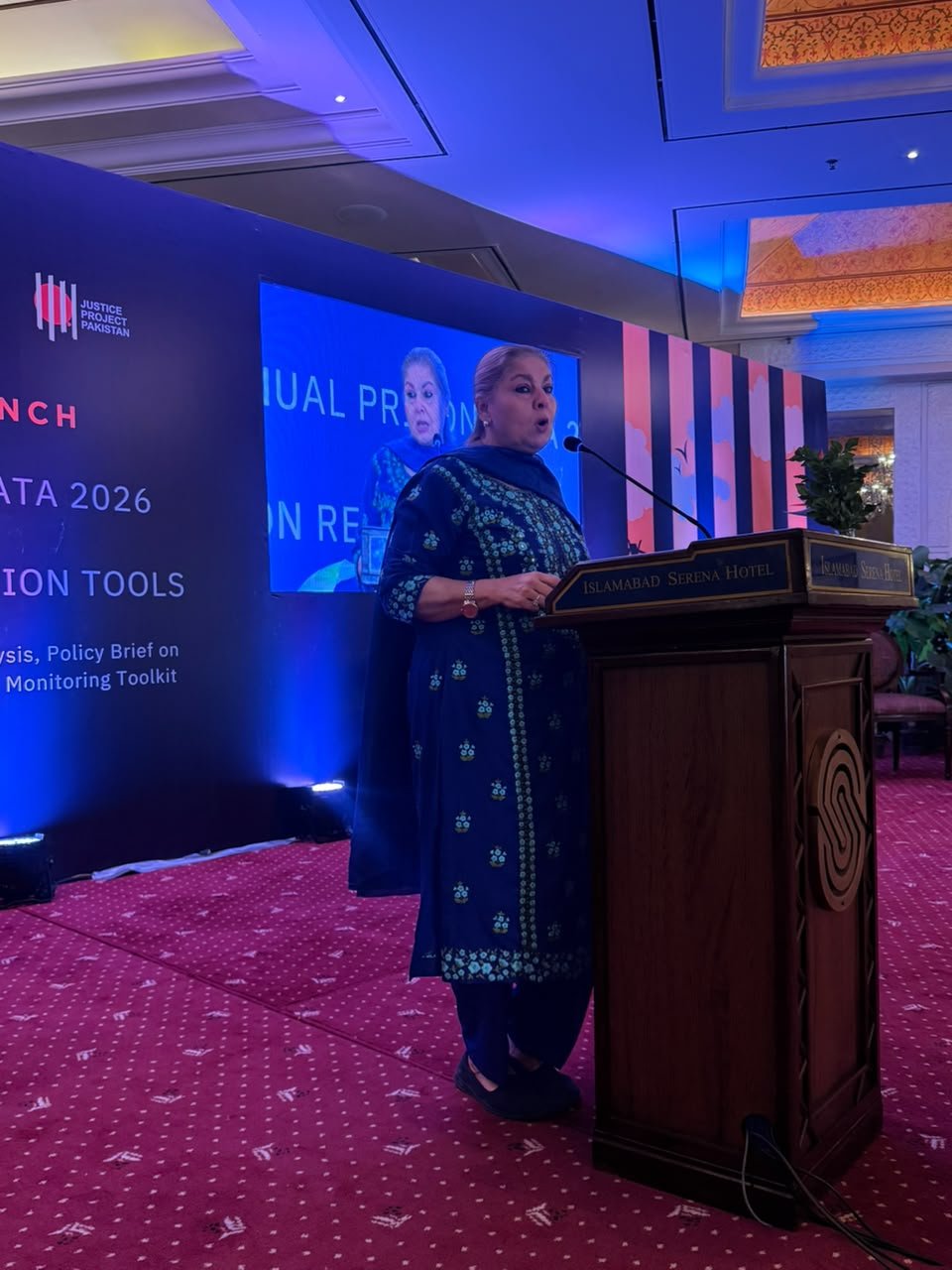
Speaking on this occasion, Chairperson NCHR Rabiya Javeri Agha said that “Pakistan does not simply have a prison overcrowding problem. We have a criminal justice problem. People enter prison faster than our justice system can process them.”
“At NCHR, we have walked through enough prison gates to know that once they close, statistics stop being statistics. They become years. They become children growing up without their mothers. They become lives put on hold while cases creep slowly through our courts.” She stressed for examining the systemic causes of prolonged detention, delays in trials, barriers to bail and the limited use of alternatives to imprisonment.
The challenge now is implementation. The report and the tools launched alongside it are designed to support that next step — translating evidence into practical action to reduce unnecessary detention, reform bail and surety practices, address case delays, expand non-custodial measures, improve prison oversight and conditions, and tackle laws and policies that drive unnecessary incarceration.
The full report and accompanying Key Findings are available at:
Google Drive Folder