









Fighting Scammers and Protecting People with New Technology and Partnerships
Scammers are constantly evolving their tactics – and so is Meta. Every day, criminals use increasingly sophisticated measures to defraud people on its platforms and across the Internet. That’s why Meta is announcing new investments in advanced AI, tools for people to spot and avoid scammers, and partnerships with law enforcement and industry peers for offline enforcement.
Here’s a closer look at Meta’s progress and what’s next in its fight against scams.
Using AI to Combat Celeb-Bait and Brand Impersonation
Scammers use subtle tricks and deceptive framing that are hard to catch with traditional detection systems. Meta’s experts and specialists in combating scams built advanced AI systems that can analyze multiple signals— such as text, images, and the surrounding context– to spot a broader range of more sophisticated scam patterns faster and at scale.
- Detecting impersonation: AI offers a new and different means to detect scammers who impersonate celebrities, public figures, or brands. It strengthens Meta’s abilities to analyze fake fan sentiment, misleading bios, or associations with public figures or brands. AI can process far more contextual information about public figures, enhancing Meta’s ability to catch deceptive impersonations.
- Deceptive links and domain impersonation: Meta uses use advanced AI to proactively detect and enforce against content that redirects people to webpages designed to mimic legitimate ones. This technology allows it to identify a broader range of deceptive behaviors with higher precision, to protect thousands of brands against impersonation.
Meta’s Latest Anti-Scam Tools
Across Meta apps, its systems find and remove malicious accounts. But it knows that scammers try to avoid its detection and may not immediately use accounts maliciously. Meta’s teams of experts built new tools to alert users before engaging with something suspicious.
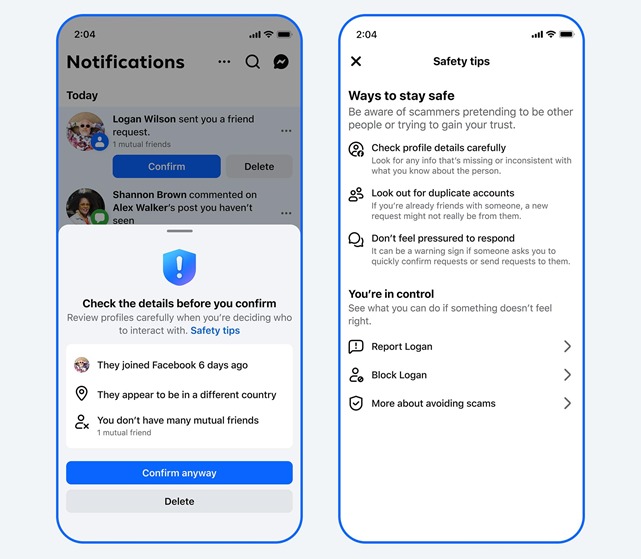
- Facebook alerts for suspicious friend requests: Meta is testing new warnings on Facebook to help users navigate suspicious accounts. When a request is sent or received from an account that shows certain signs of suspicious activity, including when one does not have many mutual friends or they indicate a different country location in their profile – users will see an alert to help make an informed decision to block or reject suspicious requests.
- WhatsApp device linking warning: Scammers may try to trick users into linking their WhatsApp account to their device. For example, they may pose as a talent competition asking users to cast the vote by going to a website and entering the phone number, followed by a device linking code on their WhatsApp. They may also try to trick users into scanning a QR code under false pretenses, which would then link the scammer’s device to users’ account.
To stay ahead of these tactics, WhatsApp will now alert its users when behavioral signals suggest a linking request might be suspicious. These alerts will show where the request is coming from and warn that it could be a scam, giving the users the chance to pause and reconsider before it happens. Visit the WhatsApp Help Center for more ways to stay safe when linking device on WhatsApp.
● Expanding advanced scam detection on Messenger: Meta is rolling out advanced scam detection on Messenger to more countries this month. When a chat with a new contact may contain patterns of common scams like suspicious job offers, it warns the users and asks if they would like to share recent chat messages for an AI scam review. If a potential scam is detected, users will get more information on common scams, and Meta will suggest actions to take including blocking or reporting the suspicious account. Learn more here.
Advertiser Verification
Meta is always working to make its platforms safer for people and businesses. Today, advertisers may be required to verify depending on factors like where they deliver ads and whether they have a history of not following its rules or the type of ads they run are more susceptible to abuse.
Meta is expanding advertiser verification, to help ensure that verified advertisers drive 90% of its ads revenue by the end of 2026, up from 70% today. It will cover the highest-risk categories, while the remaining 10% will come from low-risk businesses, like the local ice cream shop. The verification process helps promote greater transparency, limiting attempts to misrepresent advertiser identity. It is an important part of Meta’s multi-layered approach to help protect people on its apps from scams.
Taking Action Against Scammers
Meta continues to detect and disrupt sophisticated scam operations, including by working with industry peers and law enforcement around the world. This is to know that criminal networks target people regardless of borders and across messaging, dating apps, social media, crypto, and other apps.
Meta aggressively combats scam activity to protect people and businesses. Last year alone, it removed over 159 million scam ads, 92% of which it took down before anyone reported them.
Meta also took down 10.9 million accounts on Facebook and Instagram, associated with criminal scam centers. Throughout these investigations, it has observed growing a sophistication in scam operations, and the industrialization of scams continues to grow.
Meta’s global work to protect people against scammers is never done. It will continue to invest in new technologies, share updates on the progress on enforcement, and collaborate with partners to ensure a safer experience for everyone across its platforms.